In 2026, most businesses do not suffer because they have no cybersecurity tools. They suffer because no one is watching those tools closely enough.
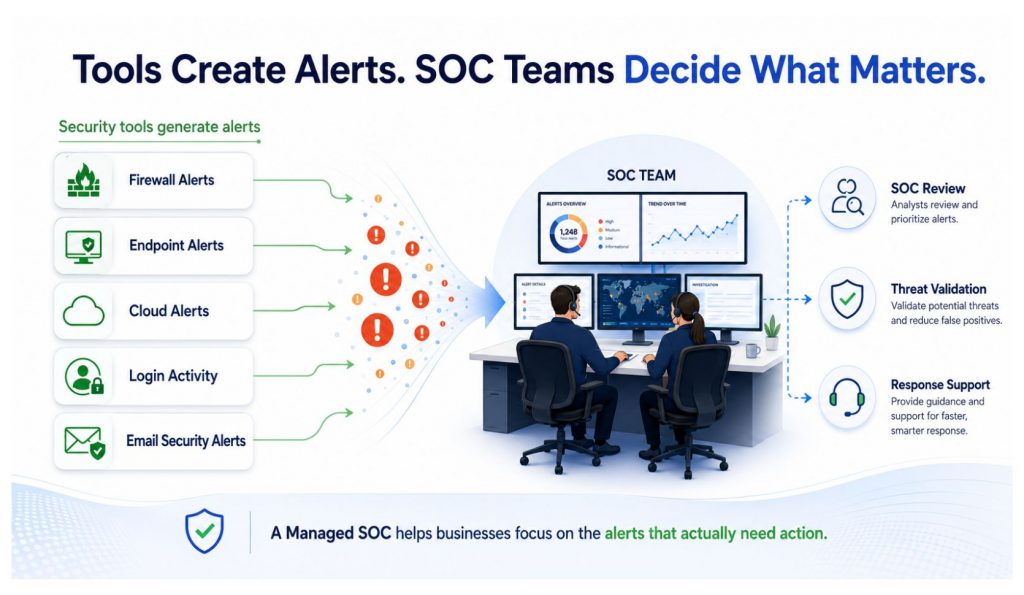
A company may already have firewalls, antivirus software, endpoint security, cloud controls, email protection, and access systems. These tools can warn the business when something looks suspicious.
But a warning is only useful when someone checks it on time.
Many security alerts are ignored, delayed, or lost in the daily workload of the IT team. Some alerts are false alarms. Some are serious. The problem is knowing which one needs action before it becomes an incident.
That is where Managed SOC services help.
A Managed SOC gives businesses a dedicated security team that monitors alerts, checks suspicious activity, identifies real threats, and supports response. Instead of only depending on tools, the business gets people and processes that help detect and respond to threats faster.
In simple terms, Managed SOC services help businesses move from having security tools to actively managing security risks.
What Are Managed SOC Services?
Managed SOC services are cybersecurity services where an external security team monitors your business for threats and helps you respond when something suspicious happens.
SOC stands for Security Operations Center.
A Security Operations Center is the team or function that watches security alerts, checks unusual activity, investigates threats, and supports response during incidents.
When this is managed by an outside cybersecurity partner, it is called a Managed SOC.
This means your business does not have to build a full security operations team from scratch. You do not need to hire several analysts, set up 24/7 shifts, manage every tool alone, or create every response process internally.
Instead, a Managed SOC provider helps you with the daily security operations work.
This usually includes:
- Monitoring alerts
- Checking suspicious activity
- Reviewing logs
- Identifying real threats
- Reducing false alarms
- Escalating serious issues
- Supporting incident response
- Sharing reports and recommendations
In simple terms, Managed SOC services help your business answer three important questions:
- What is happening in our systems?
- Is it a real security threat?
- What should we do next?
That is the real value of a Managed SOC. It gives your business more than tools. It gives you active monitoring, expert review, and a clearer response process when security risks appear.
Why Managed SOC Services Matter in 2026
In 2026, businesses are using more digital systems than ever before.
Teams work from different locations. Data is stored in cloud platforms. Employees use many devices. Companies depend on email, apps, servers, websites, and third-party tools every day.
This makes business faster and more flexible.
But it also creates more places where security problems can begin.
A suspicious login, a misconfigured cloud setting, a malware alert, or unusual user activity may not look serious at first. But if no one checks it on time, a small warning can turn into a bigger incident.
This is where many businesses struggle.
They may have the right tools, but their internal team may not have enough time to watch every alert, review every log, and investigate every warning. IT teams are often busy fixing user issues, managing systems, supporting cloud platforms, and keeping daily operations running.
Security monitoring becomes one more thing on an already full list.
Managed SOC services help solve this problem by giving businesses a dedicated security operations layer.
The Managed SOC team watches alerts, checks suspicious activity, removes noise, and focuses on the risks that actually need attention. This helps the business respond faster and avoid depending only on delayed, manual checks.
The main value is simple: Managed SOC services help businesses notice threats earlier, understand them better, and respond before the damage becomes serious.
What Do Managed SOC Services Include?
Managed SOC services usually include a mix of monitoring, investigation, response support, and reporting.
The exact service can change from one SOC provider to another, but the main purpose stays the same:
to help the business see security risks clearly and act on them faster.
Here are the key things a Managed SOC service usually includes.
1. Continuous Security Monitoring
The SOC team monitors security alerts and activity across your business environment.
This can include:
- Firewalls
- Servers
- Laptops and desktops
- Cloud platforms
- Email systems
- User login activity
- Security tools
- Business applications
The goal is to identify suspicious activity as early as possible.
For example, if an employee account has repeated failed login attempts, or if someone logs in from an unusual location, the SOC team can review it and check whether it is a real risk.
Without continuous monitoring, these signals may sit inside tools without anyone acting on them.
2. Alert Triage
Every alert is not an emergency.
Some alerts are false alarms. Some are low priority. Some need quick action.
Alert triage means reviewing alerts and deciding which ones actually matter.
This is one of the most important parts of Managed SOC services because many businesses suffer from too many alerts and not enough time to check them properly.
A Managed SOC team helps reduce this noise.
They look at the alert, understand the context, check related activity, and decide whether it needs attention.
3. Threat Detection
Threat detection means finding signs of real cyber risk.
This could include:
- Malware activity
- Unusual user behavior
- Suspicious file movement
- Unauthorized access attempts
- Abnormal cloud activity
- Signs of phishing or account takeover
The SOC team does not only wait for obvious attacks. They also look for patterns that may show something is wrong.
This helps the business catch threats before they become larger incidents.
4. SIEM Monitoring
A SIEM is a tool that collects security logs from different systems and brings them into one place.
For example, logs from firewalls, cloud platforms, endpoints, and login systems can be connected to the SIEM.
This gives the SOC team better visibility.
Instead of checking ten different tools separately, they can see related security activity in one place and connect the dots faster.
5. Incident Response Support
When a real threat is found, the business needs to know what to do next.
Managed SOC services usually include incident response support to help the team take the right steps.
This may include:
- Confirming the incident
- Informing the right people
- Recommending containment steps
- Helping investigate the issue
- Guiding the next action
The goal is to reduce confusion during a security incident.
A clear response process can help the business act faster and limit damage.
6. Reporting and Recommendations
A Managed SOC should not only send alerts.
It should also help the business understand what is happening over time.
Reports may include:
- Number of alerts reviewed
- Serious incidents found
- Common types of threats
- Repeated security gaps
- Response actions taken
- Recommendations for improvement
This helps business leaders and IT teams make better security decisions.
Over time, these reports can also show whether the company’s security posture is improving.
Managed SOC vs In-House SOC
A common question businesses ask is:
Should we build our own SOC or use Managed SOC services?
Both options can work. But they are very different in terms of cost, effort, time, and responsibility.
An in-house SOC means the company builds its own security operations team. It hires analysts, buys tools, creates monitoring processes, sets up shifts, and manages everything internally.
A Managed SOC means the company works with an external SOC provider. The provider helps monitor alerts, detect threats, investigate issues, and support response.
For many businesses, building an in-house SOC sounds good in theory. But in practice, it can be expensive and difficult to manage.
You need the right people, the right tools, and the right process. You also need coverage beyond normal working hours because cyber threats do not follow office timings.
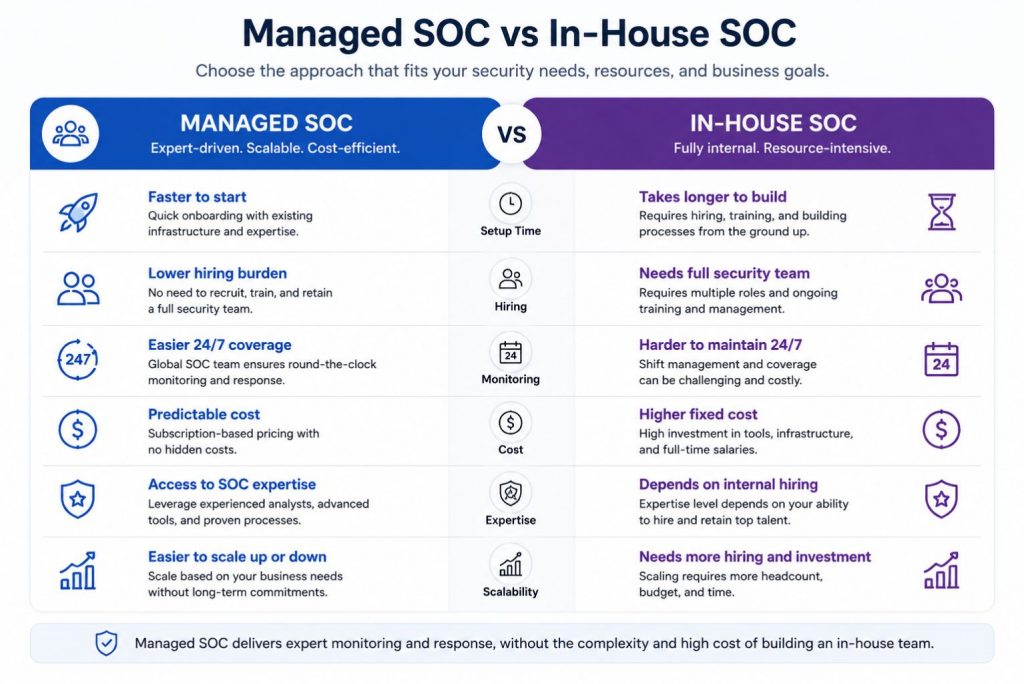
Here is a simple comparison:
| Area | Managed SOC Services | In-House SOC |
|---|---|---|
| Setup time | Faster to start | Takes longer to build |
| Hiring effort | Lower hiring burden | Requires security analysts and managers |
| Cost | More predictable | Higher fixed cost |
| 24/7 monitoring | Easier to achieve | Harder and more expensive |
| Expertise | Access to experienced SOC team | Depends on internal hiring |
| Scalability | Easier to scale up or down | Needs more hiring and investment |
| Management | Provider handles daily SOC operations | Business manages everything internally |
For some businesses, SOC as a Service may be a better fit when they want flexible security monitoring without building everything internally. For companies that already have a security team but need extra analyst support, SOC Staff Augmentation can help extend their existing security operations.
An in-house SOC may make sense for large companies with bigger budgets, mature security teams, and complex internal requirements.
But for growing businesses, Managed SOC services are often more practical.
They help the business get security monitoring and response support without spending months building a full SOC from the ground up.
The main difference is simple:
An in-house SOC gives you full control, but it also gives you full responsibility.
A Managed SOC gives you faster access to SOC capability with less internal burden.
How to Choose the Right Managed SOC Provider
Choosing the right Managed SOC provider is not just about choosing a tool. It is about choosing a team that can monitor your environment, understand your risks, and guide your response when something suspicious happens.
A good SOC provider should clearly explain what they monitor, how they review alerts, how they separate real threats from false alarms, and what happens when an incident is confirmed. They should also provide clear reports, useful recommendations, and work with your existing security tools wherever possible.
The right SOC company should feel like an extension of your security team, not just a vendor sending notifications.
For businesses that want practical security operations center services without building everything in-house, this is where SOCRoom can help.
How SOCRoom Helps with Managed SOC Services
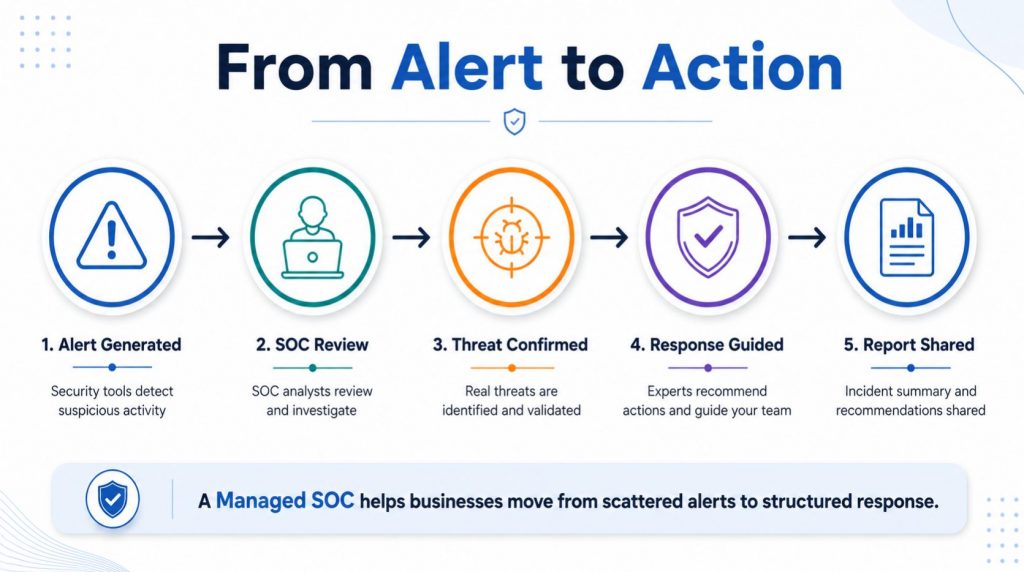
SOCRoom helps businesses move from passive security tools to active security monitoring and response.
Instead of leaving alerts scattered across different tools, SOCRoom helps monitor security activity, review suspicious events, identify real threats, and support response when action is needed.
This gives businesses a clearer view of what is happening across their environment and helps reduce the risk of missed alerts, delayed response, and confusion during incidents.
For companies that do not want to build a full in-house SOC, Managed SOC services offer a practical way to get continuous monitoring, expert review, and structured response support.
Cybersecurity in 2026 is not only about having the right tools. It is about making sure those tools are being watched, understood, and acted on at the right time.
That is the role of a Managed SOC.
If your business needs continuous monitoring and response without building a full SOC in-house, explore SOCRoom’s Managed SOC Services.